Home Guide · 5 min read
How to Find and Turn Off Your Home's Main Water Shutoff in Broomfield
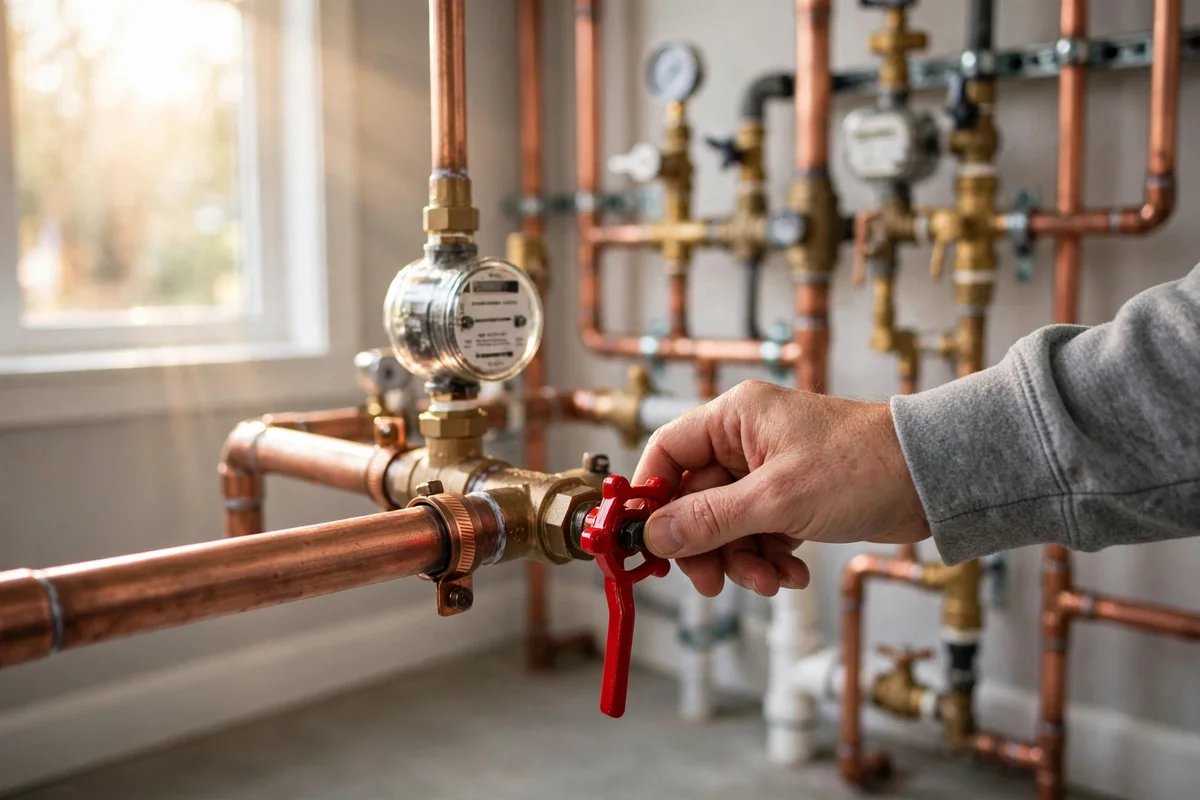
A burst supply line can release several gallons a minute. The difference between a mop-up and a five-figure repair is often one valve: the main water shutoff, which stops every tap, toilet, and appliance — if you can find it in an emergency. Most homeowners have never touched theirs. This guide fixes that: where the valve hides, how the two types work, and the step people forget afterward.
Where the main shutoff usually is
Follow the water line in from the street. In most single-family Broomfield homes, the main shutoff sits where that line enters: a basement wall on the street side, a utility room, a garage wall, or a crawl space near the foundation. Look for the pipe coming through the wall or floor near the water meter or water heater — the valve is on that pipe, before it branches off. In condos and townhomes, check a hallway access panel, the laundry room, or under the kitchen sink.
Ball valve or gate valve: how to tell
There are two types, and they close differently. A ball valve has a straight lever handle: parallel to the pipe means on, a quarter turn to perpendicular — crossways — means off. It is the more reliable design, and its handle shows its state.
A gate valve has a round wheel handle and takes several full clockwise turns to close. Gate valves are older and more prone to seizing after years untouched. If one will not move, do not force it — a corroded valve can snap its stem inside the wall. A stuck valve is a job for a plumber, not a bigger wrench.
Turn it off, step by step
In an emergency:
- Close the main valve: quarter turn for a lever, clockwise until it stops for a wheel.
- Open the lowest faucet and an outside spigot if you have one. This drains the lines and relieves trapped pressure; the flow should slow to a stop, confirming the valve is holding.
- If the water will be off for hours, protect the water heater: a heater running without water can destroy itself. Electric elements burn out in minutes when not submerged — plumbers call it dry firing. Switch an electric heater off at its breaker; for gas, turn the control knob to “off” or “pilot.”
- Deal with the leak: mop up, move belongings out of the water’s path, photograph damage if safe, and call for burst pipe repair if a pipe has split.
Safety first: if water has reached outlets or the electrical panel, shut off power at the main breaker, and never touch a panel with wet hands.
Turning the water back on
Open the valve slowly — a sudden rush can hammer pipes. Open the highest faucet and let it run until the flow is steady; early sputtering and cloudiness is trapped air working its way out. Only after the tank has refilled and a hot tap runs steady should you switch the water heater back on.
Want ClearFlow Plumbing Experts to look at this in person?
Get Help 24/7 — (720) 731-0573If you cannot find it, or it will not move
Check the other usual spots: the wall opposite the hose bib, the utility closet, or the crawl space access. The last resort is the curb stop at the meter box near the street, which needs a long T-shaped meter key — but that valve usually belongs to the water utility, so treat it as their job and call City and County of Broomfield utilities if your house valve has failed. As a stopgap, fixture valves under sinks and behind toilets can isolate one fixture. And if a valve is seized, corroded, or missing, have a plumber fit a modern lever valve.
Make it a ten-minute household drill
Do this once, before you need it. Find the valve, confirm which type it is, and hang a tag on it so anyone can spot it. Show every adult in the house how it closes. Test it yearly: close it, confirm a faucet stops, then reopen it fully. Keep a clear path to it; in a flood, you do not want to be moving stored boxes to reach it.
Frequently asked questions
Should I turn off the water when I go on vacation?
For trips longer than a few days, yes. A small leak that would be a puddle while you are home becomes days of running water while you are away. Shut off the main valve, and switch the water heater off too.
What if my home has no main shutoff valve?
Some older homes rely on the street-side curb stop alone. If you cannot find an indoor valve, a plumber can install a modern lever shutoff where the line enters the house. Until then, know where your meter box is.
Why is the water cloudy after I turn it back on?
That is trapped air, not contamination. Open the highest faucet and let it run until the stream is steady and the cloudiness clears. If it persists after a day, have the lines checked.
Need a plumber in Broomfield?
Tell us what is going on and we will connect you with an independent local plumbing provider who can help.
Get Help 24/7 — (720) 731-0573